🏰 The Digital Fortress: A Comprehensive Analysis of Family Protection in the Cyber Frontier
“A real man protects his family everywhere. Especially online.”
Cinematic Introduction: The Porous Walls of the Modern Sanctuary 🏠
The architecture of the modern home has undergone a radical transformation, moving from the physical and tangible to the digital and ethereal. In the previous century, the security of a household was defined by the strength of its deadbolts, the height of its fences, and the vigilance of the neighborhood watch. Today, while those physical barriers remain, the most significant vulnerabilities exist in the invisible streams of data flowing through the air. The sanctuary of the living room is no longer an isolated space; it is a node in a global network, connected to billions of other devices, some of which are piloted by malicious actors with intents ranging from petty theft to systemic extortion.
Imagine a quiet evening in a typical suburban household. The doors are locked, and the alarm system is set. Inside, the family is engaged in what appears to be harmless digital activity. A father is finalizing a bank transfer on his laptop; a mother is sharing vacation photos on social media; a teenage daughter is streaming a video on her tablet; and a ten-year-old son is immersed in a multiplayer online game, chatting with peers through a headset. To the naked eye, this is a scene of domestic peace.
However, to a cybersecurity expert, this home is a series of open windows. The father’s banking session is occurring over a router with outdated firmware, susceptible to a “Man-in-the-Middle” attack. The mother’s social media posts are being scraped by data brokers to build a “pattern-of-life” profile that includes the family’s home address and daily routines. The daughter’s streaming app is leaking location metadata, and the son, unbeknownst to him, is being engaged in conversation by a predator using an AI chatbot designed to mimic the language of a ten-year-old. This is the silent siege of the twenty-first century. The responsibility of the protector has shifted; the modern guardian must now become a digital sentry, understanding that the “home” now extends into the digital ether, and the protection of one’s kin requires a sophisticated understanding of the tools and tactics of the cyber frontier.
The Hidden Dangers of the Internet: A Taxonomy of Digital Threats ⚠️
The internet is often likened to a public square, but a more accurate cinematic equivalent would be a sprawling, unregulated mega-city. While it offers unparalleled access to information and connection, it also houses sophisticated criminal enterprises and predatory individuals. The dangers facing a family are multifaceted, evolving from simple viruses to complex, AI-driven psychological operations.
The Ransomware Ultimatum and Emotional Leverage 🛑
One of the most devastating threats to a household is ransomware. Unlike traditional theft, which deprives a victim of physical assets, ransomware hijacks the intangible assets that hold the highest emotional value: memories. The story of Alina’s mother serves as a seminal example of this digital extortion. Just two days before Thanksgiving, her laptop was compromised by CryptoWall, an encryption malware that locked 5,726 files. These were not just documents; they were a decade of family photos, videos, and personal records.
The attackers presented a cold, time-sensitive ultimatum: pay $500 in Bitcoin within the first week, or the price would double to $1,000 before the files were permanently deleted. This scenario highlights a critical aspect of modern cybercrime: the exploitation of the non-technical user. Alina’s mother was forced to navigate the complex world of cryptocurrency during a major snowstorm that had closed her local banks. The attackers were not merely stealing data; they were selling back the victim’s own life.
| Aspect of Ransomware Attack | Mechanism of Impact |
| Initial Infection | Often occurs through a phishing email or a compromised download. |
| Encryption | Files are rendered unreadable using military-grade algorithms. |
| The Ransom Note | A digital ultimatum appears, often with a ticking clock to induce panic. |
| Payment Method | Usually involves cryptocurrency (Bitcoin) to ensure the attacker’s anonymity. |
| Psychological Toll | Victims experience extreme stress, fear of loss, and a sense of violation. |
OSINT and the Chain of Exposure 🔍
A motivated attacker does not always need to “hack” a system in the Hollywood sense. Instead, they utilize Open-Source Intelligence (OSINT) to piece together a family’s life from publicly available data. This process is disturbingly methodical. It begins with a name—perhaps an uncommon last name shared by a spouse or child. A search of social media leads to a geotagged photo at a local park or restaurant. Cross-referencing this with property records or real estate listings reveals the home address.
Once an address is obtained, the attacker can enter it into data broker websites to receive a full profile on every resident, including phone numbers, email addresses, and a list of relatives. The final link in this chain often comes from fitness applications like Strava. These apps track running or cycling routes that frequently start and stop at the user’s front door. Even with privacy settings enabled, data can leak through group challenges or shared segments. The result is a “pattern-of-life” targeting package that tells an intruder exactly when the house is empty and which routes the children take to school.
The Rise of AI-Driven Predation and Voice Cloning 🤖
The advent of Artificial Intelligence has compressed the timeline for these attacks. What once took days of manual research now takes minutes for an AI model. Furthermore, AI has introduced the “deepfake” as a weapon of domestic terror. Cybercriminals can now scrape audio from a family member’s social media video to create a realistic voice clone. A parent might receive a frantic call from what sounds exactly like their child, claiming to be in an accident or in legal trouble, demanding an immediate wire transfer.
In the realm of childhood safety, the threat has escalated from human predators to AI chatbots. These bots are programmed to groom children through gaming platforms and messaging apps, mimicking the interests and slang of their target’s age group. In some cases, AI is used to create “sextortion” material, where innocent photos of teenagers are manipulated into explicit deepfakes used for blackmail.
The IoT Foothold: Vulnerabilities in the Smart Home 🏠🔌
The “Smart Home” has effectively turned the family residence into a massive, unsecured network of “Internet of Things” (IoT) devices. Many of these gadgets—smart fridges, baby monitors, connected thermostats—are manufactured with a priority on convenience rather than security. A vulnerability in a connected coffee maker might seem trivial, but to a hacker, it is a gateway. Once an attacker gains access to one device on the home network, they can “pivot” to more sensitive systems, such as the laptop used for online banking or the tablet containing personal health information. Reports have surfaced of hackers accessing baby monitors not just to watch, but to speak to children, creating a chilling sense of invasion.
| Smart Home Vulnerability | Risk to the Household |
| Default Passwords | Many users never change the “admin/admin” credentials, allowing easy entry. |
| Lack of Updates | IoT devices are rarely patched, leaving them open to known exploits. |
| Eavesdropping | Compromised cameras and microphones allow for physical spying. |
| Botnet Recruitment | Devices are hijacked to participate in massive DDoS attacks. |
| Data Leaks | Habits, such as when the lights are turned on/off, reveal when a home is unoccupied. |
Why Online Protection Matters for Families: The High Cost of Vulnerability 💸
The digital world is no longer an optional space; it is the primary environment for education, finance, and socialization. Consequently, the risks of being “online” are no longer confined to the digital sphere; they have tangible financial, psychological, and social consequences.
The “Clean Slate” Identity Theft 🆔
While most adults worry about their own credit scores, children are often the most valuable targets for identity thieves. A child’s Social Security number is a “clean slate” with no debt and no negative history. Fraudsters can use this information to open lines of credit, apply for government benefits, or even secure employment, all while the child remains unaware. Because parents rarely check their children’s credit reports, this theft can persist for over a decade. The damage is often only discovered when the child reaches adulthood and attempts to take out a student loan or rent an apartment, only to find their financial reputation ruined before it has even begun.
The Social and Mental Health Impact: Cyberbullying 📱💔
The prevalence of cyberbullying has turned the internet into a psychological minefield for the youth. Statistics from 2024 and 2025 indicate that over 54% of children aged 12-17 have experienced some form of online harassment. This is not merely “kids being kids”; it is a targeted, often anonymous campaign that can follow a child into the safety of their bedroom.
| Platform | Prevalence of Cyberbullying Among Youth |
| YouTube | 79% |
| Snapchat | 69% |
| Tik Tok | 64% |
| 49% |
The impacts are profound, leading to increased rates of anxiety, depression, and social isolation. Victims of cyberbullying are often hesitant to report these incidents to their parents for fear of losing their digital privileges, creating a cycle of silent suffering. Furthermore, the use of AI to generate humiliating content has made the “bully’s toolkit” more dangerous than ever before.
Economic Realities: The Escalating Costs of Cybercrime 📉
The financial burden of cybercrime is staggering. In the 2024-2025 reporting period, the average self-reported cost of a cybercrime incident for an individual was $33,000. On a national scale, the FBI reported that losses from online scams reached a record $16.6 billion in 2024. For a family, a single successful phishing attack or a compromised bank account can mean the loss of a college fund or a mortgage payment.
| Cybercrime Category (2024) | Total Financial Losses (FBI IC3) |
| Investment Fraud | $6.57 Billion |
| Tech Support Scams | $1.46 Billion |
| Personal Data Breaches | $1.45 Billion |
| Confidence / Romance Scams | $672 Million |
| Identity Theft | $174 Million |
These figures illustrate that the “hidden dangers” are not just technical glitches; they are part of a massive, global redistribution of wealth from the vulnerable to the criminal.
How VPNs Help Protect Your Digital Life: The Architecture of the Tunnel 🛡️🏛️
In the face of these sophisticated threats, the Virtual Private Network (VPN) emerges as one of the most effective tools for domestic digital defense. To the non-technical reader, a VPN might seem like complex software, but its core function can be understood through a simple architectural analogy.
Encryption: The Armored Courier 🚚🔐
If the internet is a public highway, every piece of data you send—an email, a password, a credit card number—is like a car traveling down that highway. Without a VPN, these cars are made of glass; anyone standing on the side of the road can see who is inside and what they are carrying. A VPN acts as an armored courier van. Before your data ever leaves your device, the VPN “encapsulates” it in a layer of military-grade encryption. Most reputable VPNs use AES-256 (Advanced Encryption Standard with a 256-bit key). The mathematical complexity of this standard is vast. A 256-bit key has $2^{256}$ possible combinations. To put this in perspective, if every human on Earth owned a supercomputer that could check a billion keys per second, it would still take trillions of years to crack a single encrypted data packet. This level of security ensures that even if a hacker manages to intercept your family’s data, all they will see is a stream of unintelligible “gibberish”.
IP Masking: The Digital Disguise 🎭
Every internet connection is assigned an IP (Internet Protocol) address, which functions like a digital home address. This address allows websites and advertisers to track your location and browsing habits. It also serves as a beacon for hackers. When a family uses a VPN, their device does not talk directly to the internet. Instead, it makes a secure connection to a VPN server. The internet only sees the IP address of the VPN server, not the family’s real home address. This process, known as IP masking, provides several critical layers of protection:
- Location Privacy: A family in New York can appear to be in London or Tokyo, making it impossible for trackers to determine their true physical location. 📌
- Anti-Tracking: Advertisers and data brokers cannot easily build a “consumer profile” of the family because their digital footprint is constantly shifting. 🚫
- Bypassing Restrictions: VPNs allow families to access educational resources or streaming content that may be geoblocked in their specific region. 🔓
The Secure Tunnel in the Public Square 🏙️
The most critical use case for a family VPN is when members are away from the home network. Public Wi-Fi—at airports, hotels, and cafes—is notoriously insecure. Hackers often set up “Evil Twin” hotspots with names like “Free Airport Wi-Fi” to lure users into connecting. Once connected, the attacker can see every unencrypted site the user visits. A VPN creates a “secure tunnel” within these public networks. Even if the Wi-Fi itself is compromised, the VPN’s encryption ensures that the data remains private and protected from “sniffing” or interception. For a “real man” protecting his family, ensuring that every family member’s phone and laptop is equipped with a VPN is the digital equivalent of ensuring they always have their seatbelts fastened.
VPN Options That Families Often Consider: A Comparative Analysis ⚖️
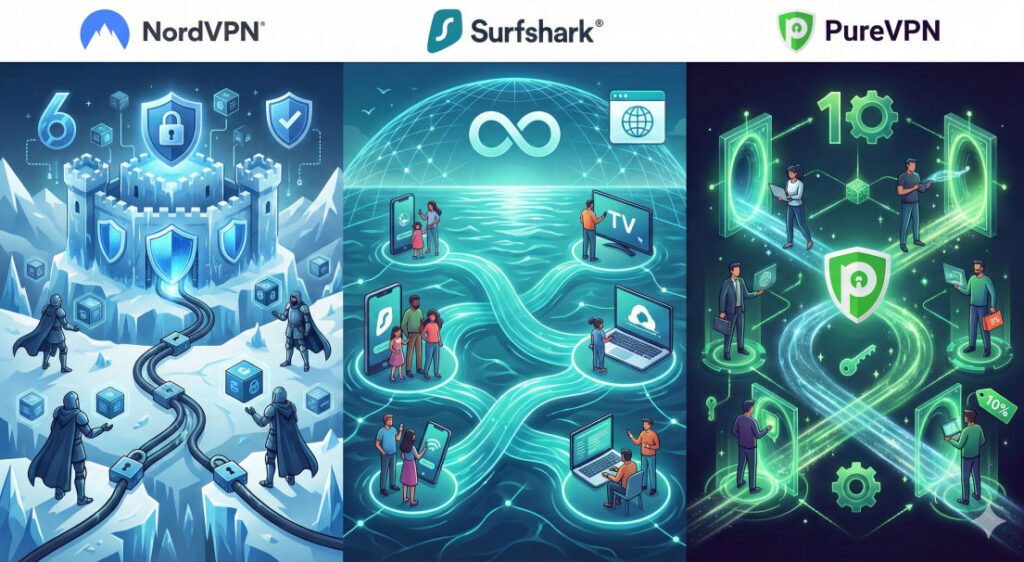
When selecting a VPN for a household, the criteria differ significantly from those of an individual user. Families require a service that is not only secure but also easy to use, affordable, and capable of protecting a wide array of devices simultaneously. Three providers—Surfshark, NordVPN, and PureVPN—are frequently at the top of the list for household protection in 2025 and 2026.
NordVPN: The Standard for Security and Speed 🏎️💨
NordVPN is often cited as the “best overall” choice for those who prioritize a comprehensive security suite. Based in Panama—a jurisdiction outside the reach of major international surveillance alliances—NordVPN has built a reputation on its strict “no-logs” policy, which has been independently audited multiple times.
- Family Benefits: NordVPN includes “Threat Protection Pro,” which acts as a lightweight antivirus by blocking malware, trackers, and malicious ads at the network level. 🛡️
- Security Features: Its specialized “Double VPN” servers route traffic through two different countries for twice the encryption.
- Performance: The proprietary “NordLynx” protocol ensures that the VPN does not significantly slow down the internet connection, allowing for high-definition streaming and gaming without buffering. ⚡
- Capacity: It allows for 10 simultaneous connections, which is sufficient for most families but may be a limitation for households with an extensive array of smart devices.
Surfshark: The Champion of the Large Household 🦈∞
Surfshark has disrupted the VPN market by offering “unlimited simultaneous connections” under a single subscription. For a family with multiple children, several tablets, smart TVs, and gaming consoles, this is a major advantage.
- Family Benefits: Beyond the device limit, Surfshark offers “CleanWeb” to filter out ads and “Alternative ID,” which allows users to generate a proxy online persona and email address to protect their real identity when signing up for websites. 🎭
- Value: Surfshark is consistently one of the most affordable premium options, making it ideal for budget-conscious families who still want top-tier protection. 💰
- Privacy: Like NordVPN, it employs RAM-only servers, meaning that all data is wiped every time a server is rebooted, ensuring no long-term storage of user activity.
PureVPN: The Budget-Friendly Family Specialist 💎
PureVPN has focused specifically on family-centric plans, offering a “Family Plan” that allows for five individual accounts under one subscription, each with its own login credentials.
- Family Benefits: This individualized approach allows parents to manage the security of their children without sharing a single password.
- Advanced Tech: PureVPN also features “Quantum-Resistant Encryption,” aimed at protecting data against the future threat of quantum computers. 🔐
- Affordability: It is often available for as low as $1.69 per month on long-term plans, making it the lowest-cost entry point into professional-grade cybersecurity. 💵
- Server Network: With over 6,500 servers in 78+ countries, it offers broad geographic coverage to help bypass regional restrictions. 🌍
| Feature Comparison (2025-26) | NordVPN | Surfshark | PureVPN |
| Simultaneous Connections | 10 Devices | Unlimited | 10 Devices / 5 Users |
| Jurisdiction | Panama | Netherlands | British Virgin Islands |
| Top Family Feature | Threat Protection Pro | Unlimited Devices | Individual Family Credentials |
| Independent Audits | Yes (Multiple) | Yes | Yes (Always-on) |
| Lowest Monthly Price | ~$3.39 | ~$1.99 | ~$1.69 |
| Encryption Standard | AES-256 | AES-256 | AES-256 (Quantum Ready) |
A Practical Approach to Family Cybersecurity: The Protector’s Protocol 🛡️💪
While a VPN provides the “walls” of the digital fortress, the inhabitants of the home must also be trained in the “art of the defense”. Cybersecurity is not a one-time setup; it is a lifestyle of resilience.
Establishing the “Human Perimeter” 👨👩👧👦🏗️
The most significant vulnerability in any network is the human element. For a family, the goal is to build a “human perimeter” where every member is trained to recognize the “red flags” of the digital world. This is achieved through the “Child-as-Teacher” model, where children are encouraged to share what they learn about online safety with their parents, fostering a culture of mutual protection.
The Family Verification Code: Defeating AI Scams 🗣️🔑
In an era of voice cloning and deepfakes, trust can no longer be based solely on what we hear or see on a screen. Families should establish a “Family Verification Code”—a simple, memorable phrase that is only known within the household. If a family member receives a suspicious call or message requesting money or sensitive information, the “Green Light” phrase must be provided before any action is taken. This simple, low-tech protocol is 100% effective against even the most sophisticated AI impersonations.
Digital Hygiene: A Checklist for the Modern Guardian 🧼💻
A family’s cybersecurity posture requires regular maintenance. The following checklist provides a roadmap for the “Chief Security Officer” of the home.
| Priority Level | Action Item | Frequency |
| Critical | Enable Multi-Factor Authentication (MFA) on all financial and social accounts. | One-time/ Per account |
| High | Update firmware on the home router and all IoT devices. | Monthly |
| High | Change all default passwords to unique “Passphrases” (e.g., mountain-bicycle-yellow-sunset). | One-time/ As needed |
| Medium | Perform a “Family Safety Meetup” to discuss any online red flags encountered. | Monthly |
| Medium | Verify that all critical family photos are backed up to an encrypted offline drive. | Quarterly |
| Routine | Run a data breach scan (using tools like NordPass or PureKeep) to see if family emails are leaked. | Monthly |
The 28-Day Masterclass for Household Resilience 🗓️🏆
Transitioning a vulnerable home into a digital fortress takes time. Experts recommend a structured, 28-day approach:
- Week 1: Hardening the Hub: Secure the router, set up the VPN on all main devices, and change default passwords on smart home gadgets. 🛡️
- Week 2: Securing the Identities: Enable MFA on every account. Move family members to a password manager to eliminate the use of weak, reused passwords. 🔐
- Week 3: Training the Sentries: Conduct “threat simulations” with children. Show them examples of phishing emails and AI-generated messages. Discuss the importance of not oversharing on social media. 📢
- Week 4: Auditing the Perimeter: Review all app permissions on phones and tablets. Delete any unused accounts. Finalize the “Family Security Agreement” that outlines the responsibilities of each member. 📋
Final Thoughts: The Legacy of the Digital Guardian 👑🛡️
“A real man protects his family everywhere. Especially online.” This opening sentiment is more than a tagline; it is a recognition of the new reality of the twenty-first century. The threats we face are no longer just physical, but psychological and digital. The loss of a child’s identity, the extortion of a parent’s memories, or the invasion of a family’s privacy through a smart camera are the “modern-day wolves” at the door.
However, as this analysis has shown, the tools for defense are as sophisticated as the weapons of the attacker. By utilizing a high-quality VPN like NordVPN, Surfshark, or PureVPN, a family can wrap their digital lives in a layer of impenetrable encryption. By establishing strong protocols like the Family Verification Code and fostering a culture of cyber-resilience, the home can once again become a sanctuary. The protector’s role has evolved. It now requires the technical savvy to navigate the settings of a router and the wisdom to guide a child through the complexities of social media. This is the legacy of the modern guardian: to build a digital fortress that allows the family to enjoy the wonders of the connected world without becoming its victims. The porous walls of the modern home can be reinforced, and in the cinematic battle between the hacker and the household, the informed and prepared family always emerges victorious. 🏁
📊 Comparison Table: NordVPN vs. Surfshark vs. PureVPN
| Feature | NordVPN | Surfshark | PureVPN |
| Max Devices | 10 | Unlimited | 10 (5 Users) |
| Audit Status | Independently Audited | Independently Audited | Always-On Audit |
| Server Count | 6,000+ | 3,200+ | 6,500+ |
| Family Perk | Threat Protection Pro | Alternative ID | Family Login System |
| Encryption | AES-256 | AES-256 | Quantum-Resistant |
❓ FAQ Section: 8 Common Questions
- What is a Man-in-the-Middle (MITM) attack? It is an attack where a cybercriminal secretly intercepts and potentially alters communication between two parties, such as a father and his bank.
- How does Ransomware exploit families? It locks emotional assets like family photos and videos, demanding a cryptocurrency ransom to regain access.
- What is OSINT? Open-Source Intelligence (OSINT) involves using publicly available data from social media and property records to piece together a family’s daily routine.
- Can AI really clone my child’s voice? Yes, cybercriminals can scrape audio from social media to create voice clones for “frantic” fake calls requesting money.
- Are baby monitors safe? If they use default passwords and lack updates, hackers can use them to spy on or even speak to children.
- Why do hackers target children’s identities? Children’s Social Security numbers provide a “clean slate” for credit fraud that often goes undetected for years.
- What is IP masking? It is a process where a VPN hides your real home address and shows the address of the VPN server instead, protecting your location privacy.
- What is the “Family Verification Code”? It is a secret phrase known only to household members used to verify identity during suspicious phone calls or messages.
💡 Beginner Tips for Families
- Establish a “Human Perimeter”: Train every family member to spot red flags like suspicious links or “frantic” requests for money.
- Use the “Child-as-Teacher” Model: Encourage your children to explain new online safety concepts they learn to the rest of the family.
- Update Your Router: Outdated firmware is a major vulnerability; check for updates monthly.
- Enable MFA Everywhere: Multi-Factor Authentication is a critical barrier for both financial and social accounts.
- Beware of Oversharing: Geotagged photos and fitness apps can reveal your home address and daily routes to intruders.